


MIL-DTL-38999 Series III circular connectors
MIL-DTL-38999 Series III
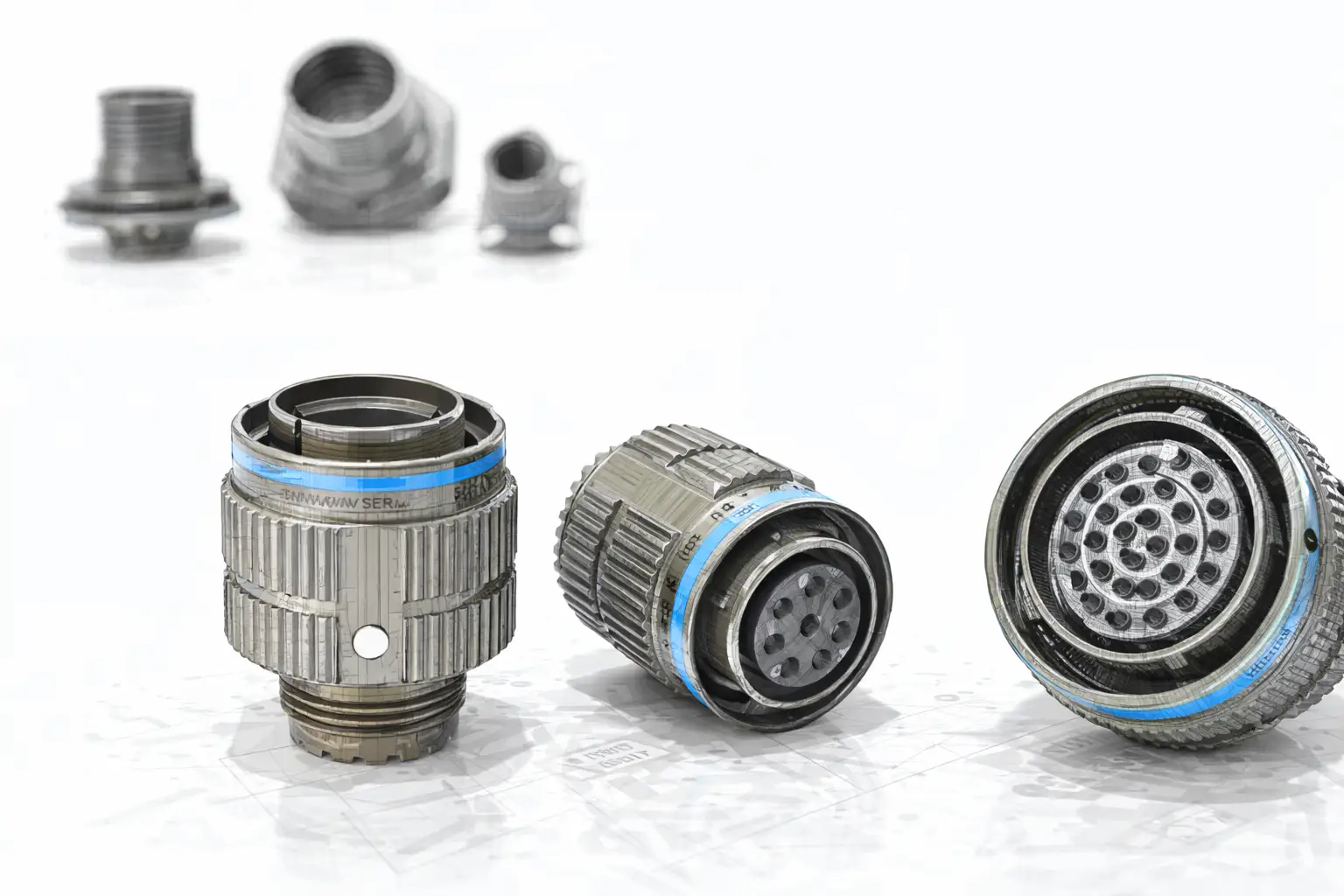
In brief. The MIL-DTL-38999 Series III is a high-density circular connector with triple-start threaded coupling, an anti-decoupling ratchet and contacts protected during mating ("scoop-proof"). Crimp contacts, 9 shell sizes (9 to 25), −65 °C to +200 °C depending on the class. We supply the original part or a Form-Fit-Function alternative, and reply within 48 working hours.
MIL-DTL-38999 has four series; Series III is the one with threaded coupling. This page explains where it is used, how to read its part number letter by letter, and what we need to find one for you.
Which equipment uses the Series III?
Equipment that vibrates hard, runs hot and is sometimes connected without line of sight. It is suited to blind mating and keeps its performance under vibration at high temperature; with the right accessories, it can also be installed in areas exposed to the weather. Its fields: aerospace, military, shipbuilding, industry and power electronics.
Metal-to-metal coupling provides ground continuity and protection against electromagnetic interference (EMI). The triple-start thread gives fast mating for a screw coupling, and the ratchet prevents loosening under vibration.
What are its technical specifications?
| Specification | Value |
|---|---|
| Coupling | Triple-start threaded, anti-decoupling ratchet |
| Contact protection | Scoop-proof: contacts protected against damage during blind mating |
| Contacts | Crimp; sizes 23, 22D, 20, 16, 12, 10 and 8 |
| Current | Power contacts up to 23 A (TE Connectivity range) |
| Density | Up to 187 data contacts (TE Connectivity range) |
| Shell sizes | 9 sizes: 9, 11, 13, 15, 17, 19, 21, 23, 25 |
| Insert arrangements | Defined by MIL-STD-1560 |
| Temperature | −65 °C to +200 °C; maximum +175 °C for some classes |
| Shielding | Metal-to-metal coupling, EMI continuity |
How do you read a MIL-DTL-38999 Series III part number?
A military part number is decoded field by field, and every field matters: two parts that differ by a single letter will not necessarily mate. Take D38999/26WB35PN.
| Field | Example | Meaning |
|---|---|---|
| Prefix and style | D38999/26 | Straight plug (/20 = wall-mount receptacle) |
| Class | W | Aluminium, olive drab cadmium, +175 °C, 500 h salt spray |
| Shell size | B | Size 11 (A = 9, C = 13… J = 25) |
| Insert arrangement | 35 | Layout 11-35, i.e. 13 contacts |
| Contact type | P | Pin contacts (S = socket) |
| Keying | N | Normal position (A to E = alternate positions) |
The last field is a frequent trap: a plug in position A only mates with a receptacle in position A. Note too that some classes carry usage restrictions depending on the armed service using them. Before replacing a part with one of another class, check your definition file.
Which finish classes are available?
| Class | Shell and finish | Max. temperature | Salt spray |
|---|---|---|---|
| F | Aluminium, electroless nickel | +200 °C | 48 h |
| K | Passivated stainless steel | +200 °C | 500 h |
| T | Aluminium, nickel-fluoropolymer | +175 °C | 500 h |
| W | Aluminium, olive drab cadmium | +175 °C | 500 h |
| Z | Aluminium, zinc-nickel | +175 °C | 500 h |
The Series III is made by, among others, TE Connectivity (Deutsch range), Amphenol and Souriau (Eaton, 8D series). Naming them helps identify a part; it does not imply that we are an authorised distributor.
Which standards apply?
| Reference | Scope |
|---|---|
| MIL-DTL-38999 revision M (11 February 2015, amendment 2 of 8 September 2017) | Specification for Series I to IV; formerly MIL-C-38999 |
| MIL-STD-1560 | Insert arrangements |
Series I, III and IV are scoop-proof; Series II is not. We therefore never offer it as a replacement for a Series III.
Your 38999 Series III connector is unobtainable: what do we do?
First, we look for the exact part number among the dormant stock holders in our European and Asian network. If there is no part, we reverse-engineer a Form-Fit-Function alternative: same thread, same insert arrangement, same keying. Patrick Roseleur, founder of Explorea, worked at Deutsch/CKB (TE Connectivity) and was rapporteur to CENELEC for EN 50467, the standard on connectors for rolling stock. Depending on your programme, an alternative may require approval from your design office: we say so in the quotation.
To quote, we need the full part number (prefix, class, shell size, insert arrangement, contact type, keying), the manufacturer's marking, a photo of the contact face, the drawing if you have it, the quantity and the deadline. If the part number is illegible, use the connector search by part number or photo.
Frequently asked questions
What is the difference between MIL-C-38999 and MIL-DTL-38999?
None on the product itself: MIL-C-38999 is the former designation of the same specification, now MIL-DTL-38999. The current revision is M, dated 11 February 2015. A part marked MIL-C-38999 Series III is therefore searched for with the same D38999 part number, using the same logic.
Can a Series III replace a Series I?
Not directly. The Series I uses quick-disconnect coupling, the Series III triple-start threaded coupling: the plugs of one series do not mate with the receptacles of the other. Moving from one to the other means changing the complete pair, plug and receptacle.
What if the requirement exceeds 23 A?
In the TE Connectivity 38999 Series III range, power contacts go up to 23 A. For links from 100 to 800 A, look at our DTAT8 power connectors, a separate family designed for high currents.
Get a quote for your connector
The full range is on our defence connectivity page.
Request a quote for a MIL-DTL-38999 Series III connector
Reply within 48 working hours.