


MIL-DTL-26482 Series II circular connectors
MIL-DTL-26482 Series II
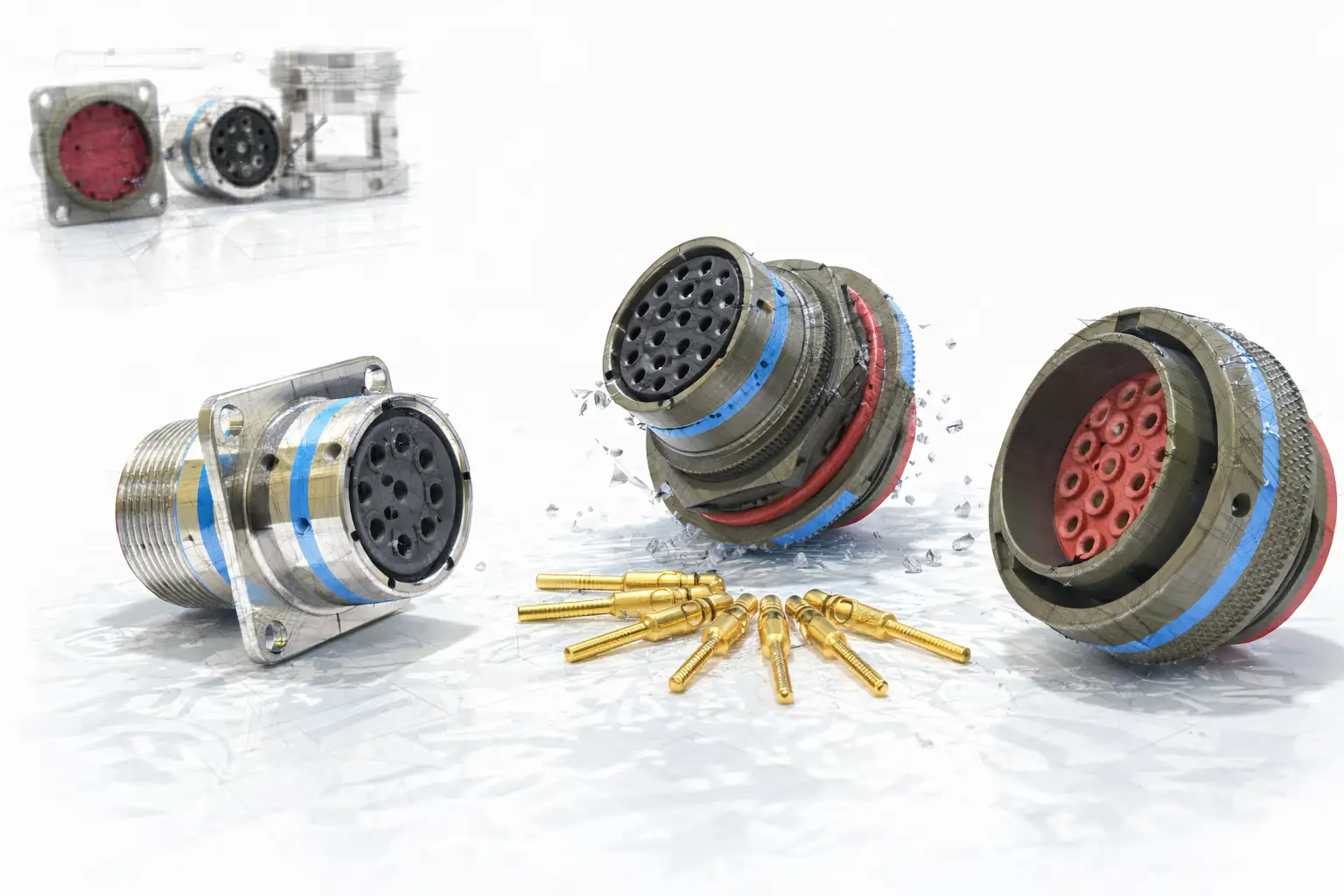
In brief. The MIL-DTL-26482 Series II is a miniature circular connector with bayonet coupling whose crimp contacts are inserted and removed from the rear. 9 shell sizes (8 to 24), 33 insert arrangements from 3 to 61 contacts, up to +200 °C depending on the class. We supply the original part or a Form-Fit-Function alternative, and reply within 48 working hours.
The Series II was designed as an evolution of the Series I. This page sets out what it changes for maintenance, its finish classes, its operating voltages and the information we need to find one for you.
What does the Series II offer over the Series I?
Above all, repairability: a crimp contact is removed from the rear with a tool, with no desoldering. For an MRO workshop, that is the difference between replacing a contact and replacing the connector.
| What changes | Series II | What it means for you |
|---|---|---|
| Contacts | Crimp (M39029), rear release | A damaged contact can be replaced on its own |
| Tool | A single plastic tool to insert and remove | No heavy tooling in the workshop |
| Wire sealing | Triple seal per cavity | Sealing maintained over a wide range of wire diameters |
| Temperature | Up to +200 °C (classes A and L) | Versus +125 °C for the Series I with solder contacts |
| Compatibility | Intermateable with the Series I | Replacement possible, except with shielded contacts |
| Lineage | Identical to the former MIL-DTL-83723 Series I, now inactive | A 83723 Series I part can also be searched for as a 26482 Series II |
That last point is useful on legacy equipment: a drawing that cites MIL-DTL-83723 Series I is not a dead end.
Where is the Series II used?
Wherever a general-purpose miniature circular connector with bayonet coupling is needed: military, aerospace and commercial systems, according to the manufacturer Conesys. It carries signal and power in tactical systems, aircraft and defence equipment. Its mechanical performance is documented: when mated, it withstands a 300 g shock for 3 ms on all three axes, with no loss of continuity longer than one microsecond.
What are its technical specifications?
| Specification | Value |
|---|---|
| Coupling | Bayonet, fully locked in 1/3 of a turn (120°) |
| Contacts | M39029 crimp contacts, sizes 20, 16 and 12, wire from 24 to 12 AWG |
| Shell sizes | 9 sizes, from 8 to 24 |
| Insert arrangements | 33, from 3 to 61 contacts (MIL-STD-1669) |
| Indicative operating voltage (sea level) | 600 V rms (service I) or 1,000 V rms (service II) |
| Temperature | −55 °C to +200 °C (classes A, L); −55 °C to +175 °C (class W) |
| Durability | 500 mating cycles (MS3476 plug), 250 (MS3475 plug with RFI grounding) |
| Keying | Alternate insert positions |
Manufacturers give these voltages as a guide for the designer, not as a guaranteed value. The specified test voltages decrease with altitude.
Which finish class should you choose?
The class depends on the environment. In a salt-laden atmosphere, salt spray resistance clearly separates the finishes.
| Class | Shell and finish | Max. temperature | Salt spray |
|---|---|---|---|
| A | Aluminium, black anodised | +200 °C | 500 h |
| L | Aluminium, electroless nickel | +200 °C | 48 h |
| W | Aluminium, olive drab cadmium over nickel underplate | +175 °C | 500 h |
As for styles, the Series II has four receptacles (narrow flange, wide flange, cable-connecting in-line, and jam nut with O-ring) and two plugs: the standard MS3476 and the MS3475 with RFI grounding. Conesys and Amphenol, among others, manufacture them; naming them helps identify the part and does not imply that we are an authorised distributor.
Which standards apply?
| Reference | Scope |
|---|---|
| MIL-DTL-26482 revision H (20 February 2007, amendment 2 of 21 June 2013) | General specification for Series I and II |
| MIL-STD-1669 | Insert arrangements |
| M39029 | Crimp contacts |
| MIL-DTL-83723 Series I (inactive) | Connectors identical to the Series II |
Your Series II is no longer manufactured: what do we do?
Two routes, in this order. First, the original part, sought in the dormant stock we tap into across Europe and Asia. Failing that, a Form-Fit-Function alternative designed by reverse engineering, which fits in place of the original. Patrick Roseleur, founder of Explorea, worked at Deutsch/CKB (TE Connectivity) and was rapporteur to CENELEC for EN 50467, the standard on connectors for rolling stock. Depending on your programme, an alternative may need approval from your design office; we state this in the quotation.
What saves us time: the full part number (for example MS3470L14-12P), the class read from the marking, a photo of each face, the drawing if you have it, the quantity and the deadline. If the part number is illegible, use the connector search by part number or photo.
Frequently asked questions
What is the difference between MIL-DTL-26482 Series II and MIL-DTL-83723 Series I?
Functionally, none: manufacturers state that Series II connectors are identical to MIL-DTL-83723 Series I, a specification that is now inactive. If your parts list cites a 83723 Series I, we widen the search to the 26482 Series II, which improves the chances of finding an original part.
Can a single contact be replaced?
Yes, that is the whole point of the Series II. M39029 contacts are crimped and then held by a metal retention clip; a plastic tool inserted from the rear releases the clip and the contact comes out. You need the right tool for the contact size, and a new contact with the same part number.
Does the Series II hold up in a marine environment?
It depends on the class. Classes A (black anodised) and W (olive drab cadmium) withstand 500 hours of salt spray, class L (electroless nickel) only 48 hours. For shipborne or port equipment, check the class letter in the part number before ordering a replacement.
Get a quote for your connector
See the full range on our defence connectivity page.
Request a quote for a MIL-DTL-26482 Series II connector
Reply within 48 working hours.