


MIL-DTL-26482 Series I circular connectors
MIL-DTL-26482 Series I
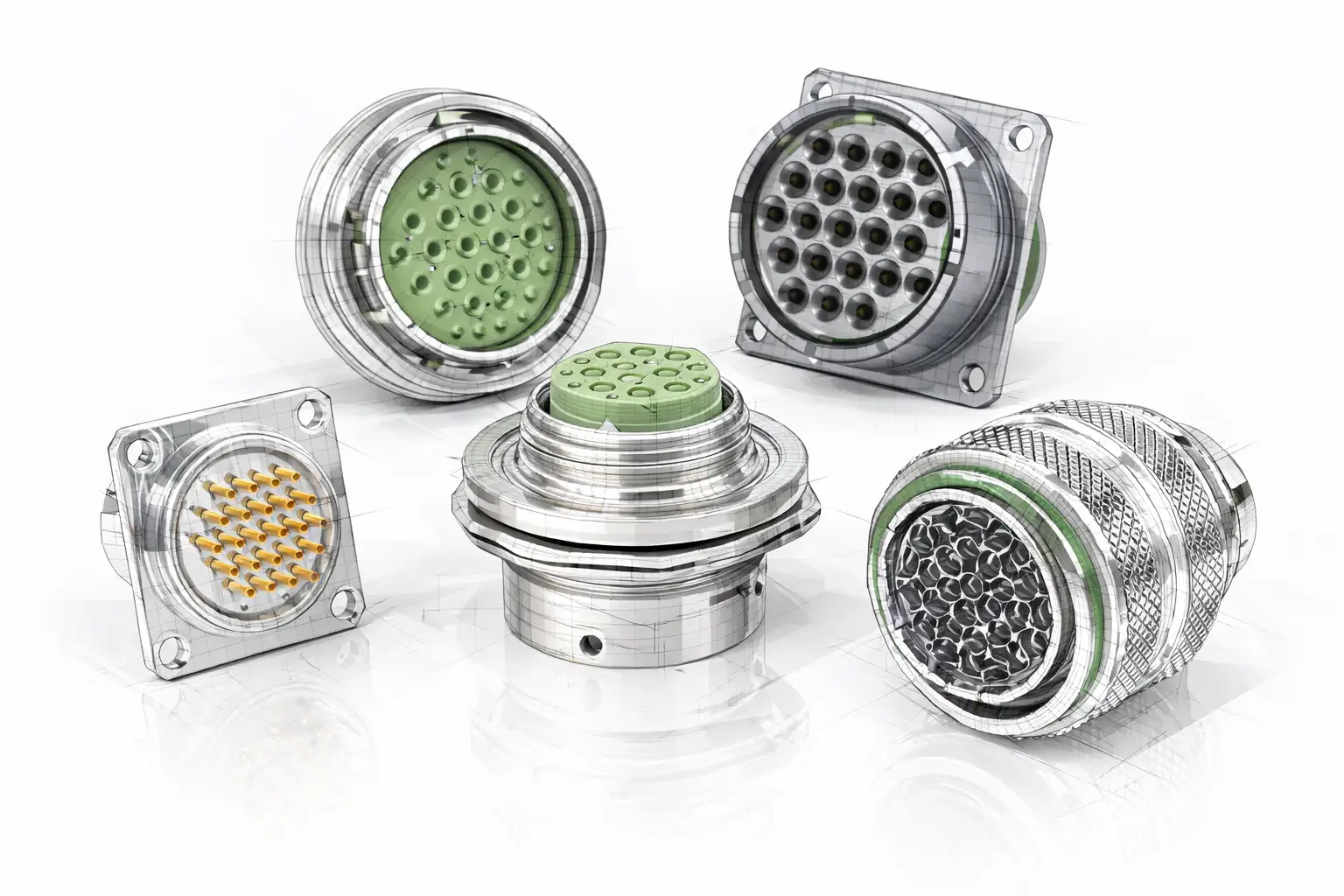
In brief. The MIL-DTL-26482 Series I is a miniature circular connector with bayonet coupling, defined by the US military specification MIL-DTL-26482. Solder contacts, locking in a third of a turn, 9 shell sizes (8 to 24), 2 to 61 contacts, −55 °C to +125 °C. We locate the original part or design a Form-Fit-Function alternative, and reply within 48 working hours.
This page helps you identify a Series I with certainty before you search for one: specifications, a table so you never confuse it with the Series II again, the MS codes to read on the part, and what we need to quote.
What is a MIL-DTL-26482 Series I connector used for?
It connects signal and power circuits on equipment that must stay sealed and disconnect quickly: military, aerospace and industrial hardware. The specification describes it as "environment resisting, quick disconnect, miniature"; common versions reach IP67. Its main asset is still the bayonet. A third of a turn is enough to lock it, where a threaded coupling takes several: on cramped equipment, handled with gloves on, you feel the difference.
What are its technical specifications?
A Series I is recognised by three features: solder contacts only, a 120° bayonet, and an even-numbered shell size between 8 and 24.
| Specification | Value |
|---|---|
| Coupling | Bayonet, fully locked in 1/3 of a turn (120°) |
| Contacts | Solder only, sizes 16 and 20; PC tail contacts for printed circuit board mounting |
| Shell sizes | 9 sizes: 8, 10, 12, 14, 16, 18, 20, 22, 24 |
| Number of contacts | 2 to 61 depending on the insert arrangement |
| Insert arrangements | 30 standard arrangements (MIL-STD-1669) |
| Operating temperature | −55 °C to +125 °C |
| Sealing | IP67 (common versions) |
| Keying | Normal, W, X, Y, Z orientations |
| Standard finish | Olive drab cadmium; other finishes, including RoHS |
There are five styles, each with its own MS code: MS3116 straight plug, MS3110 wall-mount receptacle, MS3112 box-mount receptacle, MS3114 jam-nut receptacle and MS3111 cable-connecting receptacle. MS3116 parts appear, for example, in the Amphenol and Souriau-Sunbank (Eaton) catalogues; naming them helps identify the part and does not imply that we are an authorised distributor.
Series I or Series II: how do you tell which one you have?
Look at the back of the connector. Wires soldered to fixed contacts: Series I. Crimp contacts removed from the rear with a tool: Series II. The engraved MS code settles any doubt.
| Criterion | Series I (this page) | Series II |
|---|---|---|
| Termination | Solder only | Crimp, rear release |
| Contact sizes | 16 and 20 | 20, 16 and 12 (M39029) |
| MS codes | MS3110, MS3111, MS3112, MS3114, MS3116 | MS3470, MS3474, MS3475, MS3476 |
| Maximum temperature | +125 °C | +175 °C or +200 °C depending on the class |
| Insert arrangements | 30 standard | 33 qualified |
The two series mate with power contacts, not with shielded contacts. The manufacturer Conesys presents its Series II as intermateable and interchangeable with the Series I. Replacing an unobtainable Series I with a Series II is therefore often possible, but not always: we check your insert arrangement before proposing it.
Which standards apply?
The reference document is MIL-DTL-26482, revision H. An older drawing may say "MIL-C-26482": same family, former designation.
| Reference | Scope |
|---|---|
| MIL-DTL-26482 revision H (20 February 2007, amendment 2 of 21 June 2013) | General specification for Series I and II; supersedes MIL-C-26482G |
| MIL-STD-1669 | Insert arrangements |
Obsolete MIL-DTL-26482 Series I connector: what do we do?
First, we look for the identical part in the dormant stock held across our network in Europe and Asia: same part number, no documentation to update. If it no longer exists, we reverse-engineer a Form-Fit-Function alternative with the same envelope, the same mating interface and the same insert arrangement. Patrick Roseleur, founder of Explorea, worked at Deutsch/CKB (TE Connectivity) and was rapporteur to CENELEC for EN 50467, the standard on connectors for rolling stock. One limit to be aware of: depending on your programme, the alternative may need approval from your design office. We flag this at the quotation stage.
To get a quote, send us:
- the full part number engraved on the shell (for example MS3116F12-8S);
- the manufacturer's markings and date code, if legible;
- one photo of the contact face and one side view;
- the drawing or parts list, if you have it;
- the quantity and the deadline.
Part number illegible? Use our connector search by part number or photo.
Frequently asked questions
Can a Series II replace a Series I?
Often, yes. Its manufacturers present the Series II as intermateable and interchangeable with the solder-contact Series I. The limit lies with shielded contacts, which neither series mates with. We check the insert arrangement and contact type before proposing this substitution to you.
What does "MIL-C-26482" mean on an old drawing?
It is the former designation of the same specification. Revision H of MIL-DTL-26482, dated 20 February 2007, supersedes MIL-C-26482G. A part marked MIL-C-26482 therefore belongs to the same family, and its MS codes (MS3116, MS3110…) remain the best key to finding it.
How quickly will you get a reply?
We reply within 48 working hours. Lead time for supply then depends on the route chosen, original part or alternative, and is stated in the quotation. A full part number, sharp photos and the target quantity let us give a more precise answer from the very first exchange.
Get a quote for your connector
The full range is on our defence connectivity page. For power links, see our DTAT3 military connectors.
Request a quote for a MIL-DTL-26482 Series I connector
Reply within 48 working hours.